

Ressources dossier
AgroecologyData: the raw material of agricultural innovation
To support research and the scaling-up of solutions suitable for agriculture, AI relies on vast amounts of data. It is the quality of this data that enables AI to help professionals anticipate health and climate-related risks; optimise the use of production or management tools and relieve them of repetitive tasks.
Published on 12 February 2026

In agriculture, as in other sectors, the uses of AI are stimulating research. ‘AI complements statistical tools that have been around for ages. It adds new building blocks that make it possible, for example, to estimate the outcomes of experiments that are costly to conduct under real field conditions, and to steer them in the right direction from the outset. We also observe qualitative advances where predictive models already exist, notably with digital farm twins. While these are complex to build and validate, AI helps us improve them and fine-tune their parameters,’ explains Vincent Guigue, a data science specialist and professor of computer science at AgroParisTech. He supports the growing integration of AI in education and research.
According to Pauline Ezanno, Head of the INRAE Animal Health Division, training researchers in AI is a key challenge currently facing public research. She warns of ‘the risk of a two-tiered research landscape, with those left standing on the platform and those boarding the AI high-speed train’. Researchers with the skills to mobilise advanced AI methods are now in high demand in agronomy, as in many other sectors.
Deep learning, generative AI—every form of AI is now used in research that underpins innovation in agriculture. Their contribution depends fundamentally on the quality of the data collected. Two perfect examples are digital twins and satellite-based observation.
Digital twins: tactical and strategic tools
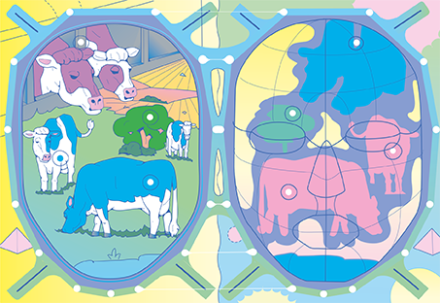
A digital twin is the most comprehensive model possible of an industrial process, a machine or a natural phenomenon, designed with the aim of ensuring its monitoring and/or maintenance. Compared with conventional models and simulations, its originality lies in the exchange of data between a real entity (the physical twin) and a virtual entity (the digital twin). In a traditional model, a human modeller intervenes to either feed experimental results into a model, or transfer simulation outputs into actions on the real system. In the case of a digital twin, synchronisation between the real and the virtual is more advanced, thanks to a more or less automated data flow between the twins.
The construction of this mirrored reality draws on various data science and AI techniques based on dynamic observation and physical modelling of the target systems. It anticipates and simulates their behaviour under a wide range of conditions, from the most common to the most extreme, thereby enabling optimised management in collaboration with the human operator.
In agriculture, with the growing number of sensors used on farms and the increasing volume of data collected, the digital twin of a farm can become a day-to-day decision-support tool for farmers and livestock producers. It can help them adjust cropping or livestock management decisions according to short- or medium-term climate forecasts. The scenarios generated by a digital twin can also help forecast future developments and anticipate changes inside a farm.
The new power of space-based observation
Another rapidly evolving field is satellite remote sensing and image processing, which provide information on plant height and other crop growth indicators that researchers are beginning to use. This requires the processing of very large volumes of data. Before the advent of AI, this analysis demanded long hours of work by experts to interpret images and translate them into usable technical information. Today, AI makes it possible to handle this mass of information more rapidly and autonomously.
In the forestry sector, a genuine revolution has been under way for the past three years. ‘Major bottlenecks that had persisted for 50 years have been removed by AI: we can now produce maps of the outlines and heights of individual trees. We can then estimate biomass, carbon stocks and monitor their evolution. The same will soon be possible for biodiversity,’ explains Jean-Pierre Wigneron, Research Director at INRAE’s Soil–Plant–Atmosphere Interactions (ISPA) unit. We are now able to track annual forest growth and changes in biomass over the past ten years at a spatial resolution of 30 metres, to assess forest health status and to identify risk areas, including degradation linked to human activities, fires, dieback caused by drought and pest attacks.
‘Major bottlenecks that had persisted for 50 years have been removed by AI: we can now produce maps of the outlines and heights of individual trees.’
Jean-Pierre Wigneron
The international One Forest Vision initiative (OFVi), in which INRAE is involved, is carrying out the same monitoring for tropical African forests and the first maps have already been produced. ‘We are now applying these same methods to agriculture to carry out similar, near-real-time monitoring of crop growth and generate alerts related to phytosanitary attacks. For the moment, this remains trickier because, for example, annual variations in tree height are substantial, whereas in agriculture we are dealing with variations of a few centimetres per month. But things are moving fast,’ Jean-Pierre Wigneron believes.
The Evergreen project team —a partnership between INRAE, Inria and CIRAD— is also pushing forward on the exploration of satellite data and using AI to develop new forms of analysis for agriculture and environmental applications. The programme, launched in 2024 for a ten-year period, supports ‘a project to monitor deforestation in Africa conducted with Wageningen University, and a land-use mapping project on Réunion Island funded by #DigitAg,’ explains project team leader Dino Ienco of the Tetis joint research unit.
Twinfarms: Digital twins under construction
Launched in February 2025, the Twinfarms project is the winner of a tender launched by the Agroecology and Digital Technology PEPR programme. It is led by the Alliance H@rvest endowed chair of the AgroParisTech Foundation and brings together Acta and numerous other partners. Over a four-year period, Twinfarms will roll out nine digital twin demonstrators across France and assess their added value in supporting tactical or strategic decision-making in the context of the agroecological transition.
‘We will work to ensure that the digital twins constructed for these nine demonstrators contribute to the emergence of generic components that are useful for future developments and re-usable by other farms,’ explains Sophie Martin, an INRAE researcher and coordinator of the TwinFarms project, which funds five PhD contracts.
inSiliCow: A virtual farm
INRAE researchers Charlotte Gaillard from the Pegase joint research unit and Olivier Martin from the MoSAR joint research unit are co-leaders of a digital twin project based on inSiliCow, a simulator and virtual dairy unit designed to manage a real dairy cow farm. Launched in 2024 for a four-year period, inSiliCow is a flagship project of the DIGIT-BIO metaprogramme led by INRAE.
By leveraging AI, the digital twin will generate multi-scale simulations in which different management strategies for individual animals, the herd and the farming system can be tested. ‘We can predict milk production and its composition at the next milking session based on different feeding scenarios,’ explains Charlotte Gaillard.
The virtual farm acts as a decision-support tool for farmers, helping improve the economic, social and environmental performance of their livestock operations.
-
Anne-Lise Carlo
(Send email)
Author / Translated by Emma Morton and AI
-
Véronique Bellon-Maurel, Jean-Pierre Chanet, Claire Rogel-Gaillard
Scientific pilots