

Ressources dossier
AgroecologyAI as a driver of innovation in renewed agricultural practices
By analysing large-scale datasets on climate, soils and crops, AI enables farmers to gain efficiency, save time and reduce costs, while limiting the environmental impact of certain practices. How, in concrete terms, is AI reshaping agricultural practices today? This special feature takes a detailed look.
Published on 11 February 2026

‘The right dose, in the right place, at the right time’: this stated objective of precision agriculture has underpinned the promotion of digital technologies in agriculture since the 1990s. By drawing on sensors, algorithms, geolocated agricultural machinery, software and digital advisory services, farmers are gradually able to better control and limit the use of fertilisers, water and pesticides, while also improving the management of animal feeding.
Innovation in tools, innovation in practices
Agricultural equipment and tools are being transformed through algorithms, robotics and automation based on deep learning.
For more than 20 years, digital services developed by public research and numerous private companies have been designed to improve yield forecasting in diverse and fluctuating environments, thereby helping farmers adjust their technical practices and livestock management practices. AI now appears to have the potential to take these tools and methods an unprecedented step further in terms of precision and decision support for farmers.
Thinking about AI in agriculture means envisaging a highly connected and automated form of agriculture that harnesses these new levers to support resilience and sustainability across the entire sector. Agricultural equipment and tools are being transformed through algorithms, robotics and automation based on deep learning. They monitor crops, predict yields, detect biological and environmental stresses, manage natural resources (water, beneficial organisms, etc.) and track animal behaviour. AI analyses data from sensors, biological measurements, drones and satellites to obtain recommendations and actions that optimise agricultural resources. ‘Rather than precision agriculture, a term long in use, the idea is more generally digital agriculture, in which AI is now mobilised through tools and practices that are both high- and low-tech,’ says Samuel Soubeyrand, a researcher in the Biostatistics and Spatial Processes unit (BioSP) and Deputy Head of INRAE’s Plant Health and Environment Division.
High-tech: Refers to cutting-edge technologies and the industries that use them (for example, AI embedded in robots).
Low-tech: Refers to a category of sustainable, simple, accessible and resilient techniques that produce repairable and adaptable objects (for example, a mobile phone application).
Making day-to-day farming easier
Thanks to AI, several solutions available to farmers represent real added value in optimising production and reducing the physical burden of certain repetitive tasks. Since the 1990s, automated and robotic systems have been increasingly adopted in agriculture. Farmers use them for the ‘intelligent’ management of sowing, harvesting, irrigation and fertilisation of their fields, as well as for precision feeding in livestock farming. These new systems adjust plant irrigation according to crop needs, water availability and weather conditions.
Agricultural robots use AI to improve various crop management practices. For example, in weed control, AI analyses images captured by onboard cameras to distinguish weeds from crops. With successive passes, the system ‘learns’ to recognise the weeds it needs to treat (by uprooting or spraying) and becomes increasingly efficient.
Several companies are developing weed recognition technologies for targeted spraying, enabling a reduction in herbicide use. In response to labour shortages in agriculture, some autonomous robots, combined with analytical tools and AI, are able to carry out an ever wider range of tasks: soil cultivation, spraying, hoeing, and more.
$10.1 billion
Value of the global precision agriculture market in 2023
+13%
Projected annual growth of the global precision agriculture market through to 2028
Helping robots understand their environment
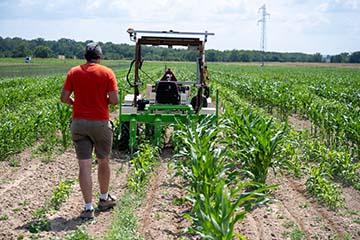
The reliability and safety of machines nevertheless remain a challenge. ‘The extreme variability of the parameters governing how a robot interacts with its environment, both in terms of control and perception (weather conditions, plant growth, etc.), requires adaptive capabilities that are difficult to implement, as they involve understanding a constantly changing context. AI will make it possible to go further in fine-grained environmental recognition, to modify robot control parameters in real time and to maintain appropriate behaviour. However, in autonomous systems, problems persist in the robot’s ability to recognise obstacles (humans or tree trunks), hazards and to adapt its behaviour,’ explains Roland Lenain, an INRAE researcher in the Technologies and Information Systems for Agrosystems unit (TSCF).
At INRAE, AI developed as part of the PARAD project of the Parsada programme I is expected to enable the real-time identification of each individual plant and even the detection of weeds within a plant cover, predicts project leader Stéphane Cordeau, a researcher at the Agroecology Joint Research Unit. The ambitious Parsada programme is designed to anticipate, innovate and support the agroecological transition and the development of alternative crop protection techniques. Launched in January 2025, it will run until December 2029.
Along similar lines, the A3P project (Anticipation, Planning and Management of Agricultural Water Withdrawals), launched in 2024 for a five-year period, is based on a dual agronomic and hydrological modelling approach. It mobilises AI and satellite imagery to anticipate changes in available water resources and crop irrigation needs in a given region. A3P is led by INRAE, Université Gustave Eiffel, and the companies Aquasys and MEOSS.
Tailored solutions for each animal
Digital technologies like sensors and automated systems have also expanded in livestock farming, making it possible to automatically record a large volume of data at the herd or individual animal level. Now processed using AI algorithms, this data enables the automated calculation of nutritional requirements and the assessment of animal welfare.
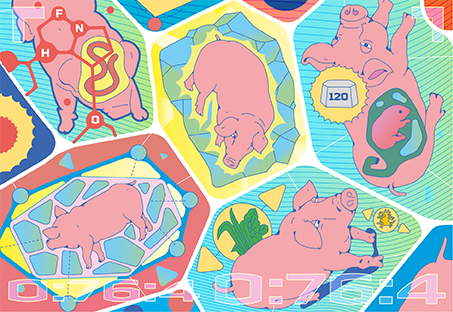
Recent work by INRAE researcher Charlotte Gaillard at the Pegase Joint Research Unit, developed in partnership with Inria and IFIP, a research and technical advisory institute for the French pork industry, has led to the implementation of customised feeding strategies —that is, the distribution of rations adjusted to the individual animal rather than the herd. These strategies reduce feed costs —and thus environmental impact— without compromising production performance.
Processed using AI algorithms, the data enables the automated calculation of nutritional requirements.
To further refine these strategies, in collaboration with the AI start-up Dilepix, the individual daily physical activity of animals is integrated into the calculation of daily energy requirements. ‘From videos recorded in livestock facilities, we can automatically and continuously distinguish sows that are standing, sitting, lying down, walking, and so on. Dilepix’s neural networks were trained using manually annotated images of sow activities in order to develop high-performance software,’ explains Charlotte Gaillard.
The emergence of AI : key milestones
1950
The intelligent machine
Alan Turing, regarded as the father of computer science, raises the question of whether machines are capable of thinking for themselves. Since then, numerous studies have proposed definitions of the concept of the ‘intelligent machine’.
1956
Artificial intelligence
At the Dartmouth Conference (United States), artificial intelligence (AI) is defined as a scientific field in its own right. In the years that followed, many methods were developed or extended as computer performance improved.
1980s
Machine learning
AI researchers develop expert systems designed to imitate the reasoning of specialists in targeted domains of knowledge. At the same time, machine learning develops further in the 1990s with the first artificial neural networks—computer systems inspired by the functioning of the human brain. This is one of the most widely known AI methods: it analyses data to infer rules to follow and self-corrects as new data become available.
Cognitive capabilities
According to the World Commission on the Ethics of Scientific Knowledge and Technology, intelligent machines are defined as being capable of imitating certain human cognitive capacities, such as perception, learning, reasoning, deduction, problem-solving, linguistic interaction and even creative production.
2000S
Deep learning
With the rise of massive datasets (big data) and computing infrastructure, learning becomes ‘deep’ (deep learning), simulating the complex decision-making power of the human brain.
2022
Generative AI
Long used primarily in its predictive form, AI becomes widely accessible through generative applications. The release of ChatGPT in 2022 accelerates the visibility and uptake of generative AI.
ChatGPT and others
ChatGPT is a conversational agent (chatbot) developed by the California-based company OpenAI. It uses large language models known as Generative Pre-trained Transformers (GPT) to generate text. In 2023, it is followed by Midjourney, Stable Diffusion, Claude, Gemini and Le Chat by Mistral AI, and more recently, in 2025, DeepSeek. Generative AI is becoming a large-scale tool for work, creation and communication. It responds to requests expressed in natural language, integrates and generates text and images in an intelligible and relevant manner, sorts and filters publications on social networks, and improves the accuracy of machine translation tools.
-
Anne-Lise Carlo
(Send email)
Author / Translated by Emma Morton and AI
-
Véronique Bellon-Maurel, Jean-Pierre Chanet, Claire Rogel-Gaillard
Scientific pilots