

Ressources dossier
AgroecologyLa Ferme Digitale: a hub for agritech innovation
Interview with Hervé Pillaud, co-founder of La Ferme Digitale Hervé Pillaud, a founding member of La Ferme Digitale, created in 2016, is the only farmer to have served on the French Digital Council (CNNum) from 2018 to 2022.
Published on 12 February 2026

What is your vision of the coexistence between agriculture and new technologies?
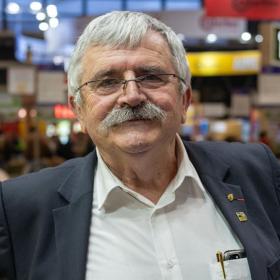
I was a farmer and livestock producer in the Vendée for 40 years. I remain very active in the sector. Being a farmer does not prevent one from being passionate about new technologies, and that is what I wanted to demonstrate as early as 2015, when I wrote the book Agronumericus (published by France Agricole editions). After that, I became an advocate for French agricultural innovation and have continued this advisory work for the agri-tech sector.
Digital technology has been everywhere for years; agriculture is no exception. At the same time, farmers face enormous challenges: to produce more, with renewable resources and with less water, less fossil fuel, fewer inputs and less arable land. Climate change has further compounded uncertainty. This is why structures like the Ferme Digitale are so important: they enable entrepreneurs in agriculture to support one another and wield innovation together in response to these challenges.
Founded in 2016, our association is now the leading agri-tech network in Europe. It brings together nearly 200 partners and start-ups from the agricultural ecosystem.
How do farmers perceive AI?
The desire for modernity has long been present among a large number of farmers; what is needed is to build their confidence. Although it is a hot news topic, AI is not new: it has been a part of our lives for years, even decades. Personally, I have always seen technology as a facilitator of daily life, much like the bank card was in its time.
‘To understand how AI works, we need to move from a culture of proof
to a culture of probability.’
The arrival of generative AI with LLMs (Large Language Models) such as ChatGPT in 2023 was a major milestone. For the first time in human history, the machine is trying to understand us and help us, whereas until now we were the ones giving it instructions. To understand how AI works, we need to move from a culture of proof to a culture of probability, while reducing the margin of error to almost zero. Farmers tolerate very little margin of error, simply because they cannot afford to absorb it.
There is no room for mistakes in agriculture, and this applies to the entire food production chain. Price pressure to grow low-cost food for the population strongly limits the capacity to innovate and invest in R&D because the sector simply lacks the means. An entrepreneur whose goal is to make money should not go into agriculture. Unicorns¹ do not exist in the agricultural sector. The French agri-tech industry is not doing well, and funding from private investors remains insufficient. This is one of the reasons why using open source and developing digital commons are the obvious solution —and something farmers, who invented the mutual model and cooperation, know how to do.
What role can this new technology play?
AI holds enormous potential for agriculture in the next ten years. For example: since humans domesticated nature, more than 6,000 plant species have been cultivated or used for food at some point in history. Today, around 200 of them are subject to intensive and regular varietal selection for agriculture. It is this varietal selection that has saved our societies from famine by stabilising production.
Thanks to AI, which can model plant genomes, we can move much faster in selecting new species to work on in an effort to adapt to the consequences of climate change. But relying on technical ‘solutionism’ as an end in itself is pointless. Instead, we need an approach that moves us forward together and is of benefit to an entire sector and, ultimately, society as a whole.
With this in mind we designed the Generative Artificial Intelligence for Agriculture (GAIA) project. This collaborative platform, which we are leading as part of La Ferme Digitale in partnership with OSFARM, INRAE, ACTA and other public and private stakeholders, aims to democratise the use of AI in agriculture. It should be seen as a collaborative tool for generating AI agents specialised in agriculture, based on an open-source core of agricultural data made available to farmers.
¹ Unicorn: a privately held company valued at more than one billion US dollars.
Accelerating joint opportunities for research and innovation
At the Paris International Agricultural Show in February 2025, INRAE and La Ferme Digitale signed a four-year partnership agreement. This milestone initiative combines INRAE’s scientific expertise with the innovative drive of start-ups to facilitate the emergence and market rollout of new technologies for sustainable agriculture. ‘Through this partnership, we can identify scientific bottlenecks faster, develop collaborative projects and joint events, accelerate the transfer of knowledge into concrete applications, and support the creation of science companies,’ says Justine Lipuma, co-founder of La Ferme Digitale and CEO of the start-up Mycophyto.
During the show, La Ferme Digitale organised its second hackathon for the GAIA platform. At the end of a 48-hour marathon, eight multidisciplinary teams of 90 participants had contributed to the development of new AI-enabled solutions to agricultural challenges. ‘It’s fascinating to see people from livestock farming, industry, cooperatives and student backgrounds work together and design concrete projects,’ explains David Joulin, co-founder of La Ferme Digitale and coordinator of the GAIA hackathon.
-
Anne-Lise Carlo
(Send email)
Author / Translated by Emma Morton and AI
-
Véronique Bellon-Maurel, Jean-Pierre Chanet, Claire Rogel-Gaillard
Scientific pilots