

Ressources dossier
AgroecologyBOTANY: Pl@ntNet, a success story
Just ten years ago, the identification of plant species was confined to a very small community of professional botanists or highly experienced self-taught amateurs. The Pl@ntNet platform has helped to shift these boundaries.
Published on 12 February 2026

‘It will never work! AI will never master botanical expertise.’ Arguments of this kind could have quashed early on one of the most remarkable achievements made by combining scientific research and participatory science. But they didn’t.
The general public driving scientific progress
With nearly 25 million users, including hundreds of thousands of active contributors, over the ten years of its existence, Pl@ntNet has demonstrated just how much science can gain by asking the general public for help. The concept is simple: users take a photo of a leaf, flower, fruit, bark or other characteristic part of a plant, and the application identifies what it is. The suggestion includes both the scientific and common name of the plant, together with a stated confidence level.
Today, more than 75,000 species are recorded in the databases of the online platform, which is linked to a free mobile application. The overarching objective of Pl@ntNet is to monitor plant biodiversity. To carry out this inventory, the platform relies on AI and deep learning. That way, active contributors who collect and review the data help build Pl@ntNet’s AI, as the system learns from the data and is then able to identify plants.
Applications for agriculture
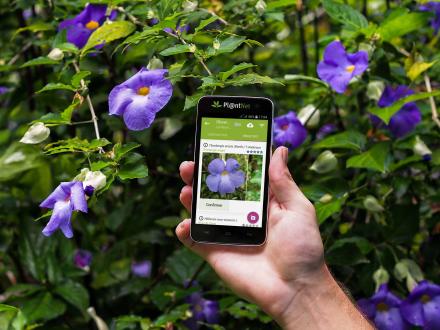
The project was developed by four French research organisations: CIRAD, Inria, INRAE and IRD. Data generated by Pl@ntNet is also used by scientists via the international Global Biodiversity Information Facility (GBIF). ‘We ourselves conduct research using this data and test new tools. We are currently developing multimodal models, themselves based on AI, in order to predict, with very high spatial resolution (50 metres), the biodiversity covering all of Europe,’ explains Alexis Joly, Scientific and Technical Director of the Pl@ntNet platform and researcher at Inria.
Farmers who have adopted an agroecological approach to preserving their soils and need to identify the plants growing among their crops also rely on Pl@ntNet. New services on the platform —enriched through joint work by AI research and plant sciences— will soon enable them to design, test and develop new uses, including the detection and recognition of plant diseases, identification at infra-specific levels, estimation of symptom severity (i.e. nutrient deficiencies, stages of decline and water stress), characterisation of combinations of species from multi-specimen images, and improved knowledge of plant species.
Launched in 2023, this new five-year project, named PlantAgroeco, is supported by the Agroecology and Digital Technology PEPR programme.
Environmental costs and risks
Along with the benefits they offer for plant knowledge, these energy-intensive applications incur environmental costs. ‘We estimate that the extended carbon footprint of Pl@ntNet —including server construction, network costs and mobile clients— is relatively low, at around 50 tonnes per year according to our estimates. This is roughly equivalent to the carbon footprint of five people in France. Work is currently under way with Paris-Saclay (LISN) and ENS Lyon to estimate our carbon footprint in greater detail,’ explains Alexis Joly.
One inherent risk for Pl@ntNet would be to not keep human expertise at the heart of the system. Currently, experts still validate both the information used by AI systems and the information they produce. Without this, there could be a drift towards degraded data quality, ultimately with negative environmental impacts. ‘AI must be a complement —a form of support— but not a substitute in our environmental policies. We must continue to train botanists,’ Alexis Joly concludes.
-
Anne-Lise Carlo
(Send email)
Author / Translated by Emma Morton and AI