

Ressources dossier
AgroecologyFacing multiple tests
French agriculture is confronting many challenges. Geopolitical and climate crises are fueling international instability, which has direct economic consequences. The agricultural world must face and overcome these difficult circumstances. State of affairs.
Published on 21 July 2026

France must tackle various economic, environmental, social, and demographic challenges if it wishes to guarantee national food sovereignty and facilitate climate and agroecological transitions.
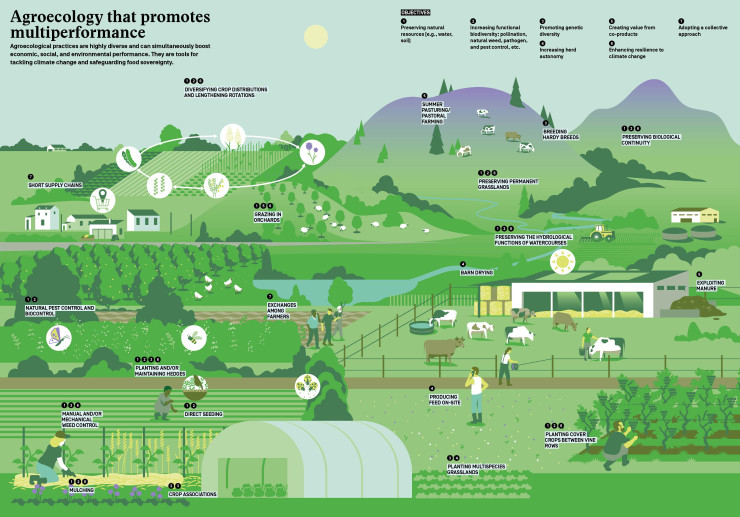
Click on the image to download it.
Varying degrees of food sovereignty
When it comes to agrifood trade patterns1, France has long been known for its unique position: it exports raw and minimally processed products and regional specialties while importing ever more fruits, vegetables, and processed foods. Currently, France ranks 6th among the world's agricultural exporters, behind the United States, Brazil, the Netherlands, Germany, and China.
After two years of strong, inflation-driven growth, French exports of agricultural and agrifood products fell to €81.4 billion in 2023, a 3% drop. The country’s trade surplus of €5.3 billion (smaller than in 2022) can largely be explained by the decrease in cereal exports (-33% compared to 2022): Ukraine and Russia returned to the world cereal market, which led to a drop in prices relative to 2022. Wine remains the most common export—it accounted for 15% of all French agricultural and agrifood exports in 2023—followed by dairy products (10%).
France imports 20% of its food, and import volumes have doubled in value since 2000. These imports include fruit, fish, and shellfish, followed by other meats and offal. This trend is partly explained by the consumption of tropical fruits and citrus fruits, which are not produced in mainland France. Furthermore, some temperate-zone fruits and vegetables, such as tomatoes, are eaten fresh year round. With regards to seafood, France has a long coastline, but most French consumers eat fish (salmon, cod) and shellfish (shrimp) that are wild caught or farmed elsewhere. Large percentages of the sheep meat and chicken consumed in France (53% and 42%, respectively) come from abroad. France generally exports fresh or frozen whole chickens, and it largely imports fresh, refrigerated, or frozen cuts or pieces of chicken. France also imports a large percentage of the durum wheat it consumes (75%).
- 6th in global exports, behind the United States, Brazil, the Netherlands, Germany, and China.
- 20% of the food consumed in France is imported (import volumes have doubled in value since 2000)
Opening markets and establishing standards
In the early 2000s, the EU began stepping up its efforts to sign trade agreements that reduced customs duties among countries. The objective was to foster trade and to facilitate the recognition of standards and protected geographical indications. There have been positive outcomes for EU agricultural and agrifood products. For instance, the trade agreement signed with South Korea led to a significant increase in the EU-27's contribution to South Korean imports over the last decade (from 8% in 2011 to 13% in 2023). A trade agreement was also signed with Canada (in 2022, 1.7% of EU agricultural imports came from Canada).
"In contrast, a free-trade agreement with Mercosur (a market comprising Argentina, Brazil, Uruguay, Paraguay, and their associate countries) could have negative consequences. Notably, Brazil already accounts for 10% of EU agricultural imports, but just 1% of EU exports,"comments Vincent Chatellier, INRAE economist (interview with Ouest France, January 2024).
Back in 2020, INRAE economists Stephan Ambec, Hervé Guyomard, and Sébastien Jean contributed to a report destined for the French Prime Minister, in which they highlighted that an opportunity had been missed to promote human and environmental health. "The [Mercosur] agreement offers the EU a chance to wield its negotiating power to obtain fundamental guarantees aligned with the environmental, health and, more generally, societal expectations held by European citizens. [...] we believe that the agreement's provisions regarding respect for the precautionary principle, commitments to the Paris Agreement, and European preferences with respect to environmental and health standards, labour standards, and animal welfare offer relatively weak guarantees."
INRAE’s EU project BATModel2 (2020–2024) developed business models to guide public policies in the direction of enhancing the sustainability and competitiveness of European agrifood industries. These models provide decision-makers with the tools they need to assess the growing challenges associated with international agrifood commerce, challenges that are significantly influenced by trade agreements.
Climate change and ecosystem preservation
The climate is changing, with conditions varying dramatically among years. The frequency and intensity of events such as droughts, heatwaves, storms, frost, precipitation, and hail are increasing. There are major impacts on the agricultural industry, including on geographical patterns of production, choices around crops and techniques, yields, and production quality. According to IPCC3, 8% of the world's current farmlands will become climatically unsuitable for agriculture by 2100; this figure is 30% in the most pessimistic scenario. Yields of major crops such as maize, soybean, rice, and wheat have already been affected. It is estimated global cereal production declined by 9–10% between 1981 and 2010.
Climate change generates conditions that favour the spread of certain plant and animal diseases, as well as the proliferation of insect pests. There is also an effect on natural resources such as water and soil, which are essential to agriculture. For example, more frequent periods of drought will force farmers to change their irrigation practices. If the soil is too wet, farm machinery cannot be used in plots, for example. Harvest dates have already been advanced in many cases, which may both reduce crop quality and complicate the daily lives of farmers, who must adjust farm planning and employee management to climate events.
Given this new reality, we need to rethink how we farm, considering both the short term, over which we need to cope with current emergencies, and the longer term, over which we need to grapple with the effects of climate change and implement lasting solutions.
Adapting via agroecology
Global food security, climate change, biodiversity preservation, and resource depletion: these are all challenges to which agroecology offers an innovative solution4.
A term defined in the French Rural Code
Agroecology was defined in Article 1 of the French Rural Code following the passage of the French law of October 13, 2014:
"Public policies are to promote and firmly establish agroecological production systems, which include organic production systems and combine economic and social performance, notably through a high level of social, environmental, and health protections. These systems boost farm autonomy and competitiveness by maintaining or increasing economic stability, improving the added value of farm products, and reducing the consumption of energy, water, fertilisers, plant protection products, and veterinary medicines, especially antibiotics. They make use of biological interactions, ecosystem services, and natural resources, especially water, biodiversity, photosynthesis, soils, and air, but they also maintain the capacity for qualitative and quantitative resource renewal. They help mitigate and adapt to the effects of climate change."
INRAE Scientific Director for Agriculture Christian Huyghe has highlighted that "adapting to climate change and restoring ecosystem services are essential tasks if we wish to ensure agricultural productivity and economic performance. Deploying agroecological strategies appears to be the most appropriate way to achieve these goals in Europe. This approach requires increasing system diversity, which means exploiting the right technological resources and rethinking human capital, both in terms of worker numbers and skills."
That said, "any advances made towards greater diversification must mobilise numerous stakeholders in a simultaneous and organised fashion,” a reflection that came from agricultural scientist Jean-Marc Meynard, animal husbandry scientist Marie-Angélina Magne (ENSFEA), and economist Marie-Benoit Magrini during a 2023 INRAE seminar devoted to diversified agricultural systems. There are ways to unite regional to international stakeholders in efforts to build more diversified and resilient agroecological farming systems. Such initiatives could include creating species mixtures or breeding species adapted to future climate conditions; promoting new agricultural practices; better situating crop systems and the resulting landscape mosaics within regions; managing agricultural and food waste to fuel the biochemical cycles that sustain living organisms; developing new food and feed products; and exploring innovations that couple agricultural production and processing.
Nourishing and creating value from regional activity
We must create value across the entire value chain to allow farmers to have satisfactory income levels and to ensure the long-term viability of their operations. A crucial role should be played by industrial and regional innovations.
Current supply chain structures force us to ponder how agricultural trade is organised, a topic of much debate among supply chain stakeholders, who are facing a polarisation between agroecological practices and increasingly competitive, globalised markets. Production contracts can provide a solution. In France, production contracts are pivotal forces driving transitions and transformations in agricultural industries, as they include clauses about production conditions in addition to sales. Consequently, they can strongly encourage the adoption of innovative production methods while simultaneously providing a secure lifeline to farmers taking the plunge. They promote coordination among agricultural stakeholders (farmers, processors, distributors) and reduce transaction costs by clearly specifying standards for production, quality, and price. However, production contracts are not legally defined. Few data are available for systematic analysis. Consequently, research has yet to examine the impact of production contracts on the agroecological transition and the adoption of sustainable farming practices5.
Regions as catalysts of change
Numerous regional initiatives are simultaneously optimising food production and promoting environmental protection, biodiversity, and animal welfare. The goal is to encourage sustainable, multiperformance agricultural systems while also maintaining and even boosting agricultural employment. One example is One Planet Business for Biodiversity. This international coalition of 26 companies is supporting biodiversity and agriculture, and, thanks to its efforts, regenerative agriculture is being used on 3.9 million hectares worldwide by around 300,000 farmers. There is also TRANSITIONS, a support programme for farmers in northeastern France that is run by the VIVESCIA, an agricultural cooperative whose collaborators include INRAE, 200 farmers, and downstream companies. The programme encourages the adoption of regenerative agriculture, a system that is both productive and good for soils and biodiversity. It provides practical and economic support to farmers. In France, certain cooperatives and large food retailers are highlighting their commitment to farmers and multiperformance agriculture through relationships with industry stakeholders. There are also brands who stand in solidarity with producers, supporting fair wages. These many initiatives reveal the presence of strong commitments and diverse strategies.
Since 2014, regional food projects (PATs) have brought together different regional stakeholders to explore the topic of food; they use an approach that accounts for the social, environmental, and economic facets of a given region. An example is the PAT of Greater Clermont and the Livradois-Forez Regional Natural Park, which was launched in 2017 and partners with INRAE. Its aim is to supply healthy, high-quality, locally produced food that is accessible to all, and, at the same time, it helps foster a form of agriculture that is more economically sustainable for farmers and respectful of the environment.
444 regional food projects (PATs) recognised by the French Ministry of Agriculture and Food Sovereignty, of which 104 are operational as of July 2024.
The programme Territoires d’innovation aims to accelerate transitions by nurturing cooperation among stakeholders. Such is illustrated by the project Dijon, Alimentation Durable 2030, which is coordinated by the city of Dijon in partnership with INRAE. Its work has demonstrated that food transitions are good for the environment, local economy, and everyday citizens and can be effectively undertaken at the regional scale6.
Christian Huyghe remarks, "While the regional scale is well suited to these transformations, all too often local agrifood industries are absent. Yet, these stakeholders play an essential role in creating added value, which is crucial to farm viability."
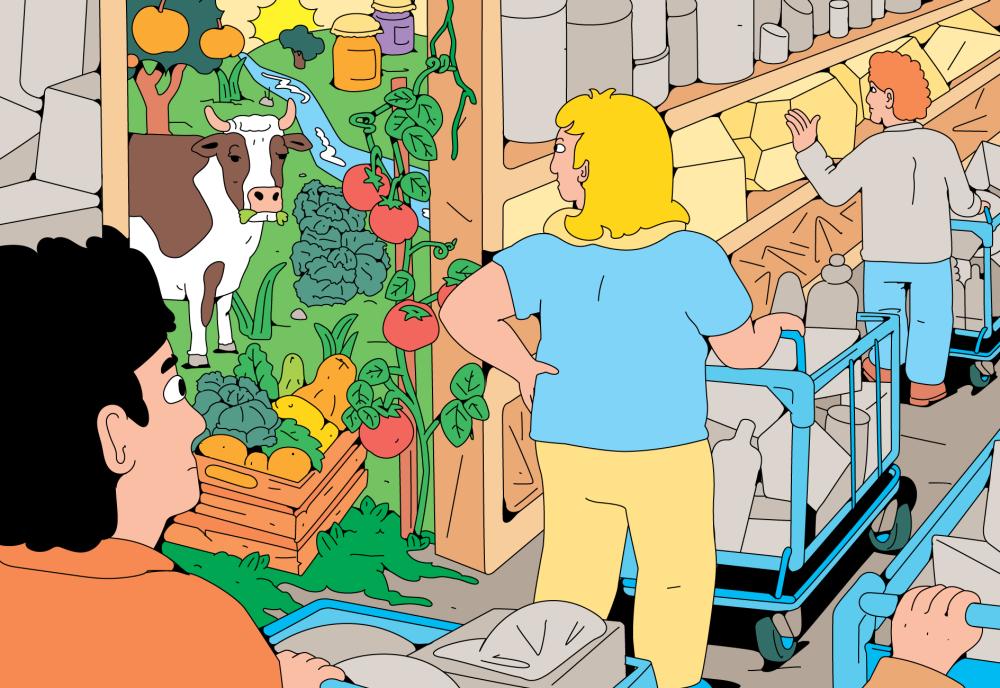
Thierry Caquet, INRAE Scientific Director for the Environment, comments, "For farmers, successfully navigating the agroecological transition may involve greater training, sharing know-how, and pooling equipment. However, shifts must also take place along the entire value chain with a view to sharing costs: for instance, it will be necessary to adapt harvesting, collection, and processing tools to handle more diversified and sometimes more heterogeneous products as well as to set up new industries and marketing practices. At the end of the supply chain, consumers play a key role because their purchasing decisions are powerful forces that can shape the entire system."
1. FranceAgriMer, HCC, Cour des Comptes (2024): url.inrae.fr/4gJEZoa; url.inrae.fr/4iNjmF9; url.inrae.fr/49S902H
2. Read the article: url.inrae.fr/3CtvPx9
3. Intergovernmental Panel on Climate Change (IPCC). Climate Change 2022 – Impacts, Adaptation and Vulnerability: Working Group II Contribution to the Sixth Assessment Report of the Intergovernmental Panel on Climate Change. Cambridge University Press, 2023.
4. Mauguin P, Caquet T, Huyghe C. L'agroécologie. Que sais-je ? PUF, 2024.
5. Magrini MB et al. (2023). Économie rurale, 385, 119–140. url.inrae.fr/402u95Y
6. Read the article: url.inrae.fr/3wg0dEP
-
Catherine Foucaud-Scheunemann
author / translated by Jess Pearce
Communication head office -
Cécile Détang-Dessendre, Nathalie Hostiou and Laurent Piet (INRAE), François Purseigle (INP Toulouse)
Scientific board
-
Lionel Serre
Illustration