

Agroecology Reading time 2 min
How does downy mildew outsmart grapevine resistance?
Resistant grapevine varieties are widely seen as a highly promising solution to downy mildew, one of the vine’s most important diseases. But the pathogen is constantly adapting. Researchers from INRAE and their US colleagues have identified two distinct adaptive strategies that enable it to overcome these resistance traits. These key findings will help scientists better anticipate how the pathogen evolves and support the long-term protection of vineyards.
Published on 31 March 2026

Grapevine downy mildew, caused by the oomycete Plasmopara viticola, is particularly difficult to control and can cause major losses in vineyards. To tackle this disease, scientists have identified numerous genes in wild grapevine species that confer partial resistance to downy mildew. For nearly 20 years, INRAE has been developing new varieties incorporating these resistance traits, notably through the ResDur breeding programme.
But this strategy faces a major obstacle: the pathogen’s capacity to adapt. In Europe, downy mildew has already shown that it can rapidly overcome several resistance factors deployed in recent years. Understanding the mechanisms involved is therefore essential if their effectiveness is to be preserved over time. Researchers from INRAE and the University of California, Davis, have identified two main strategies used by downy mildew to overcome grapevine resistance.
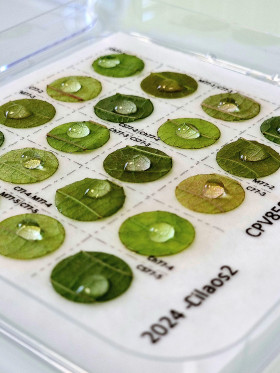
The first involves “slipping under the radar”. Grapevine resistance is based on a simple principle: the plant can recognise certain pathogen genes and trigger a defence response in the form of tissue necrosis. Some strains are able to lose fragments of the genes that trigger this response, effectively making them invisible to the plant. This adaptive mechanism has been observed repeatedly in different winegrowing regions across Europe. It highlights that the pathogen is capable of recurrent mutations, using a similar mechanism, to rapidly break down grapevine resistance.
The second strategy is based on the acquisition of new capabilities. Genetic exchanges, particularly with strains originating from North America, the pathogen’s native range, have led to the emergence of more virulent forms following their introduction into Europe and interbreeding with local populations.
By combining laboratory experiments with large-scale genetic analyses, the scientists were able to identify the genomic regions involved in these adaptations and trace their origin.
Published in PLOS Pathogens, these findings highlight the remarkable adaptive capacity of grapevine downy mildew. A better understanding of these mechanisms opens the way to more durable control strategies, for example by combining the use of resistant disease varieties with innovative prophylactic practices. Such integrated approaches are vital for preserving the health of vineyards in the face of this elusive and evolving threat.
Reference: Dvorak E, Dumartinet T, Mazet ID, Chataigner A, Paineau M, Cantù D, et al. (2026) Parallel adaptation and admixture drive the evolution of virulence in the grapevine downy mildew pathogen. PLoS Pathog 22(3): e1014041. https://doi.org/10.1371/journal.ppat.1014041