

Food, Global Health Reading time 4 min
In Nairobi, INRAE strengthens its commitment to African food systems
The final declarations of the Africa Forward Summit’s call for investment in agricultural research and partnerships with French institutions. In Nairobi, this focus led to several developments for INRAE: an agreement with IFAD, the 4th General Assembly of the TSARA initiative—which now brings together 38 institutions across 17 countries—and a partnership with Kenya’s largest university.
Published on 20 May 2026

Agricultural research: a key recommendation of the Africa Forward Summit
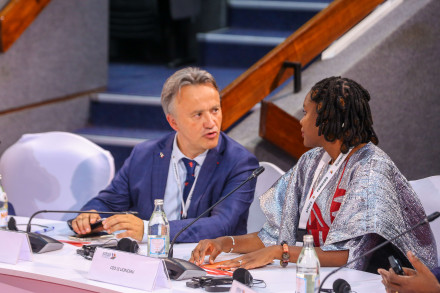
Philippe Mauguin, Chair and CEO of INRAE, was part of the French delegation at the Africa Forward Summit (Nairobi, Kenya, 11–12 May), in the presence of the President of the Republic. Together with Élisabeth Claverie de Saint Martin, CEO of CIRAD, he participated in the round table on agriculture and food, alongside African heads of state and government.
The recommendations from this round table were included in the Summit’s final declaration, which calls for greater investment in agricultural research, innovation, and climate-smart practices—notably agroecology and agroforestry—as well as in seed quality, integrated soil health management, and digital tools, by promoting research and development partnerships with French institutions. Recommendations fully in line with the work of the TSARA initiative.
“This is the very essence of TSARA—an initiative originally proposed by INRAE and CIRAD, and now developed in collaboration with 37 African and French institutes and universities, all of which have come together in Nairobi for this Summit and to attend our General Assembly.” A shared ambition: to harness advances in research—particularly in AI and remote sensing—to co-develop concrete solutions for food security, the transition of agricultural systems, and the One Health approach, while training the next generation of researchers and entrepreneurs.”
- Philippe Mauguin, Chair and CEO of INRAE
TSARA sets the course for the coming years
The challenges facing African food systems require clear, science-based solutions developed jointly through collaboration between Africa and Europe. This is the guiding principle behind TSARA (Transforming Food Systems and Agriculture through Research in Partnership with Africa), an international initiative launched in 2022 that now brings together 38 research and higher education institutions across 17 countries in Africa and Europe.
The 4th General Assembly of TSARA, held in Nairobi, defined the priorities for the coming years.
- From a scientific perspective, two key areas stand out. The first combines agroecology, water, soils, One Health, and digital technologies. It will be supported by the development of a new geospatial component—remote sensing, GIS, and participatory geomatics—reflecting a strong commitment to the agroecological transition. The second focuses on the links between production, processing, local markets, frugal innovation, and nutrition–health. A new project dedicated to product processing—both for food and non-food purposes—is being launched to support this objective.
- Practical, participatory approaches, such as living labs, should be prioritised and supported. They must combine local support for entrepreneurship with sustained dialogue with policy-makers at all levels, including the international scale. TSARA therefore aims to strengthen its influence at the science–policy interface, in line with the emphasis placed on research in the Nairobi Declaration issued following the Africa Forward Summit.
- Young people are at the heart of TSARA, through PhD contracts, mentoring, mobility schemes and networking opportunities for PhD students.
- Opening up to European partners remains a key objective. TSARA has recently joined the IRC-FNSSA (International Research Consortium on Food, Nutrition Security and Sustainable Agriculture) research group in Nairobi, a move that firmly anchors it within the African Union–European Union dialogue.

The initiative has welcomed six new members: the University of Nairobi (Kenya), the University of Sine Saloum El-Hâdj Ibrahima Niass (Senegal), the University of Dilla (Ethiopia), the EIAR, the Ethiopian Institute of Agricultural Research, the IAV Hassan II (Morocco) and the INRAB, the National Institute for Agricultural Research of Benin.
The co-chairmanship is held by INRAE and ICIPE: Philippe Mauguin serves alongside Abdou Tenkouano, Director-General and CEO of ICIPE (International Centre for Insect Physiology and Ecology, Nairobi).
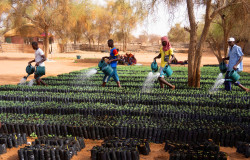
Child nutrition, the cold chain, water management, and digital and geospatial agriculture are all critical issues for African food systems—and key areas of focus for projects led by TSARA, a research network bringing together nearly forty institutions across Africa and Europe. An overview of current and upcoming projects.
By partnering with IFAD, INRAE joins forces with a second UN agency
The International Fund for Agricultural Development (IFAD) provides funding to smallholder farmers and the most vulnerable rural communities in developing countries. By signing a cooperation agreement with this UN agency—alongside CIRAD and IRD—INRAE is formalising its second partnership with a UN agency, following its earlier collaboration with the FAO.
The objective is to bridge the gap between scientific research and on-the-ground investment, in line with the 2030 Agenda and the Paris Agreement. Four common areas of work have been identified:
- Agroecological practices and pesticide reduction
- Climate change resilience and biodiversity protection
- Support for agricultural sectors and rural areas–including in fragile and post-conflict zones
- Knowledge generation to inform public policy
“In a global context marked by climate, health, and geopolitical challenges, research must, more than ever, be a tool for international cooperation. This is a firm conviction that I hold on behalf of INRAE and its researchers, as we work alongside our partners to build more resilient and sustainable agricultural and food systems.” – Philippe Mauguin, Chief Executive Officer of INRAE
School meals: another key area for cooperation
The International Fund for Agricultural Development also supports the Global School Feeding Coalition, which includes INRAE among its signatories and contributors through its involvement in the international research consortium. For INRAE, this commitment builds on its ongoing work on healthy and sustainable school meals, addressing issues related to nutrition, public policy, and food systems transformation.
INRAE's first bilateral partnership in Kenya, with the country’s largest university
INRAE has also signed a cooperation agreement with the University of Nairobi—Kenya’s largest university—in the presence of Éléonore Caroit, Minister of State for Francophonie, International Partnerships and French Nationals Abroad.
The agreement covers sustainable agriculture, agroecology, One Health, plant and soil health, water security, climate change, food processing, nutrition and health, the microbiome and digital agriculture. It outlines plans for collaborative projects, exchanges, and joint publications.
Satellites, microbiota: the collaboration of the future?
Two topics at the heart of INRAE’s international strategy were the focus of in-depth discussions on the sidelines of the Africa Forward Summit.
Geospatial technologies for agriculture The use of satellite data to monitor crops, soil, and water resources is becoming increasingly crucial for African agriculture, but it faces practical limitations: insufficient resolution in freely available imagery for monitoring small-scale family farming, dependence on external digital infrastructure, and a lack of ground-level data to train AI models. INRAE supports two international initiatives aimed at addressing this issue: One Water Vision, which develops satellite-based water information services to tackle the global water crisis, and One Forest Vision, dedicated to monitoring tropical forests in Central Africa, the Amazon and Asia. Following Kenya’s launch of its first Earth observation nanosatellite (TAIFA-1) in 2023, exchanges with the Kenya Space Agency are opening up new prospects for collaboration in this field.
The microbiome and overall health A high-level round table on Africa–Europe cooperation in higher education and research, coordinated by Paris Sciences et Lettres and co-organised by the France Team at the Alliance Française, brought together numerous African partners. Focusing on health—a shared priority for all partners—INRAE highlighted its work in nutrition and health, particularly in infant nutrition, low-cost refrigeration, and the microbiome, building on the momentum of the One Health Summit in Lyon.
Launch of the Global Microbiome Observatory
Announced at the One Health Summit, the International Microbiome Observatory—coordinated by INRAE and VIB-KU Leuven—is supported by the World Microbiome Partnership. Its primary aim is to collect one million human microbiomes by 2030, in order to establish an international scientific repository. Its scope will then be expanded to include soil, ocean, and agroecosystem microbiomes, in order to better understand their role in global health and to develop microbiome-based indicators, research programmes, and solutions.