

Biodiversity Reading time 3 min
“Human shield effect” helps golden jackals evade wolves and expand across Europe
PRESS RELEASE - Historically found in south-eastern Europe, the golden jackal was first observed in France in 2017. An international study coordinated by an INRAE scientist shows that this canid’s expansion across Europe is partly facilitated by human activity, which allows it to avoid a dominant predator and competitor: the grey wolf. Scientists analysed a dataset combining acoustic survey data, climatic and landscape variables, and wolf occurrence records from nearly 9,000 sites in 13 European countries to identify the factors affecting golden jackal distribution. Their findings, published in Nature Ecology & Evolution, show that the presence of wolves is the main factor limiting the expansion of the species. However, when wolves are present, jackals tend to concentrate near inhabited areas, where human activity reduces the negative influence of wolves on jackals, creating a “human shield” effect. The researchers project that nearly 75% of European landscapes could potentially be suitable for golden jackals.
Published on 26 May 2026

The golden jackal is a highly adaptable canid with a varied diet, feeding mainly on rodents but also on the scavenged carcasses of larger animals. As a scavenger, it plays an important clean-up role in ecosystems and helps limit the spread of disease. It is a medium-sized predator that lives in family groups. The spectacular expansion of the golden jackal across Europe is one of the most striking range shifts currently observed among mammals. Historically confined to south-eastern Europe, the species is now found across the continent, reaching the Atlantic coast in France and areas north of the Arctic Circle in Norway. Previous local studies had suggested — but not clearly confirmed — several possible drivers behind this expansion, including climate change, land-use changes and the absence of wolves, a dominant competitor that can also prey on jackals.
This new study examines the phenomenon at the scale of the entire continent using a unique dataset that combines acoustic monitoring, climatic and landscape variables, as well as comprehensive wolf occurrence data. Between 2001 and 2017, the research team studied jackal expansion across Europe using acoustic survey points at nearly 9,000 sites in 13 different countries in central and south-eastern Europe. They detected territorial groups of golden jackals, including in areas occupied by wolves. Using a statistical distribution model, they then identified the ecological and anthropogenic factors promoting the establishment and presence of the species in order to predict its future expansion.
Human activities reduce the impact of wolves on the presence of golden jackals
The results show that wolves are the main factor limiting golden jackal expansion in Europe. Jackals occur more frequently in areas without wolves and are far less likely to be found in areas where wolves are always present. However, the analyses also show that a “human shield” effect alters interactions between the two species: in the presence of wolves, jackals tend to concentrate near inhabited areas, where human activity appears to reduce the negative influence of wolves on jackals. This finding highlights that human activities do not merely alter habitats but also reshape interactions between species at the continental scale. The study therefore demonstrates that the human-shield effect can shape the distribution across Europe of a mesopredator — a medium-sized predator occupying the middle of the food chain.
The researchers project that 75% of European landscapes could potentially accommodate golden jackals, representing an area nearly six times larger than the species’ current distribution. France appears to offer the greatest potential for future expansion. Wolf recolonisation could reduce these favourable habitats in the short term but would remain partly offset by the human-shield effect. Continental and national wolf management strategies would also play a decisive role.
“The golden jackal appears to have a very promising future in Europe: our projections show that vast areas remain available for colonisation, particularly in France, which ranks among the countries most favourable to its future expansion.”
Nathan Ranc, INRAE research engineer at the Wildlife Ecology and Behaviour laboratory (CEFS)
Golden jackal profile
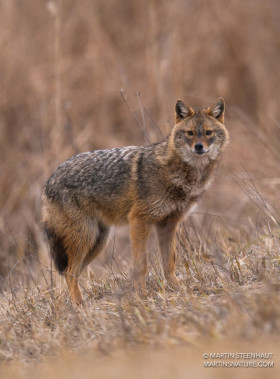
The golden jackal is a medium-sized canid, smaller and more slender than a wolf but stockier than a fox, generally weighing between 10 and 12 kg in Europe.
A highly adaptable species, it can thrive in a variety of habitats, including wetlands, different agricultural landscapes and even highly human-oriented environments where forms of cover such as hedgerows, scrub, canals or small woodland patches are available. By contrast, it generally avoids large forests, snowy mountainous areas and regions heavily occupied by wolves.
The jackal is a flexible omnivore that feeds on small mammals, birds, invertebrates, fruit, carrion and even human-derived food sources. It most often lives in territorial pairs or small family groups.
Historically confined to south-eastern Europe, the golden jackal has expanded dramatically across the continent over the past fifty years. Now present in over 20 European countries, it was recently observed for the first time in several western and northern European countries, including France, Spain, the Netherlands and Norway. The European population is currently estimated at more than 150,000 individuals.
The species is classified “least concern” by the International Union for Conservation of Nature (IUCN) and as a non-huntable game species in France. Its rapid expansion raises a number of ecological questions, particularly regarding its interactions with other wildlife species and certain human activities.
Reference
Ranc N. et al. (2026). Human shielding from wolves facilitates jackal expansion across Europe. Nature ecology & evolution DOI: https://doi.org/10.1038/s41559-026-03060-y