

Agroecology Reading time 4 min
Scientific innovation: building a bulwark against the chestnut gall wasp
The chestnut gall wasp first appeared in France towards the end of the 2000s and quickly emerged as a threat to the sweet chestnut industry, damaging the regions that traditionally grow this iconic French crop. To stop this invasion, scientists at INRAE masterminded and coordinated a vast biological counter-offensive, introducing one of the pest’s natural enemies, a parasitoid. A study by INRAE using the ASIRPA methodology, which analyses the socio-economic impacts of agricultural research, has detailed how real successes were achieved in France’s orchards and for the wider community through many years of applied research, partnerships and innovations. It tells how the general mobilisation of a whole sector enabled sustainable solutions to be found for this crisis that posed a threat to both tree health and the economy.
Published on 28 May 2026


Under attack from a tiny insect from Asia, a whole French industry swung into action. First recorded in the Alpes-Maritimes area in 2007, and with a self-sustainable population established by 2010, the chestnut gall wasp (Dryocosmus kuriphilus), a tiny wasp just a few millimetres in size, swiftly became the main pest to threaten the sweet chestnut. Laying its eggs in the tree’s buds, the wasp causes galls to form that slow the tree’s growth, affecting its architecture and strongly reducing fruit production. In the most affected orchards, harvest losses can be as much as 60 to 80%.
This predator threatens an iconic tree that has shaped the French rural landscape and economy. As the fifth largest deciduous tree crop in France, with 750 000 hectares given over to its cultivation, the sweet chestnut is still as essential to timber production as it is to the food industry, where it brings in some 50 million euros in sales. In the Ardèche, the heartland of the French chestnut trade, around 1000 jobs are directly dependent on chestnut production. In addition to the devastation of the orchards themselves, the gall wasp has also had an impact on the production of chestnut-flower honey, on woodland biodiversity, and on the tourist trade in chestnut-growing areas.
Traditional solutions proved inadequate to resolve this crisis. The use of machinery could control only small outbreaks, while the application of chemical pesticides was not suitable for the steep hillsides where chestnuts are often grown and was damaging to the environment. Scientists at INRAE’s Sophia Agrobiotech Institute at Sophia Antipolis, therefore decided to concentrate their efforts on the innovative use of long-term biological control. This biological control strategy involves the identification of a natural enemy for an invasive biological pest in its original habitat and this enemy’s subsequent introduction to the new habitat.
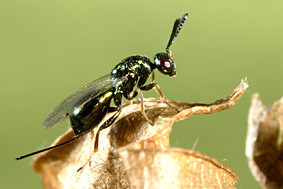
In this instance, the parasitoid micro-wasp of the species Torymus sinensis, which originated in China, was selected for introduction, having previously been identified as a natural enemy of the gall wasp in Asia. This choice was also based on successful introductions in Japan, the United States of America and, more recently, Italy, where the parasitoid had provided effective sustainable control of the pest. Between 2011 and 2014, INRAE teams coordinated the first experimental releases in France, going on to oversee their large-scale roll-out in all chestnut-producing regions.
Alongside the controlled release of the parasitoid, the research teams were careful to monitor the dynamics of the gall wasp and T sinensis populations, study how they interacted with native parasitoids, and record the ecological effects of their biological introduction. These actions enabled the teams to continually fine-tune their release strategies on the ground. The new partnership that was forged between researchers, producers, chambers of agriculture, FREDON, beekeepers and local communities enabled practical solutions to be communicated rapidly and swift action to be taken. The creation in 2012 of a French National Union of Chestnut Producers was also important in shaping a collaborative response to this crisis.
The strategy did not produce instant results, since a period of several years was required to establish T sinensis and control the invasive gall wasp populations. Over time, though, the benefits have become clear, with a reduction in gall wasp populations, a renewal of production in many chestnut-growing areas and improvements in orchard health. The positive effects have now spread beyond the chestnut-production industry itself, boosting local economic activity, supporting beekeeping, conserving landscapes and reducing the use of chemical pesticides.
This success story has been documented through a study by INRAE that uses the ASIRPA method to analyse the effects of research on social structures. The study showcases how long-term scientific research can produce operational solutions, involve a whole industry, and generate sustainable economic, environmental and social outcomes.
Reference: Christine Douchez, Nicolas Borowiec, Cécilia Multeau. Lutte biologique contre le Cynips du châtaignier : succès de l’établissement en France de Torymus sinensis. INRAE. 2026, pp.34. https://hal.inrae.fr/hal-05634469