

Society and regional strategies Reading time 3 min
Soil health: a new EU-funded project seeks to harmonise soil monitoring within Europe
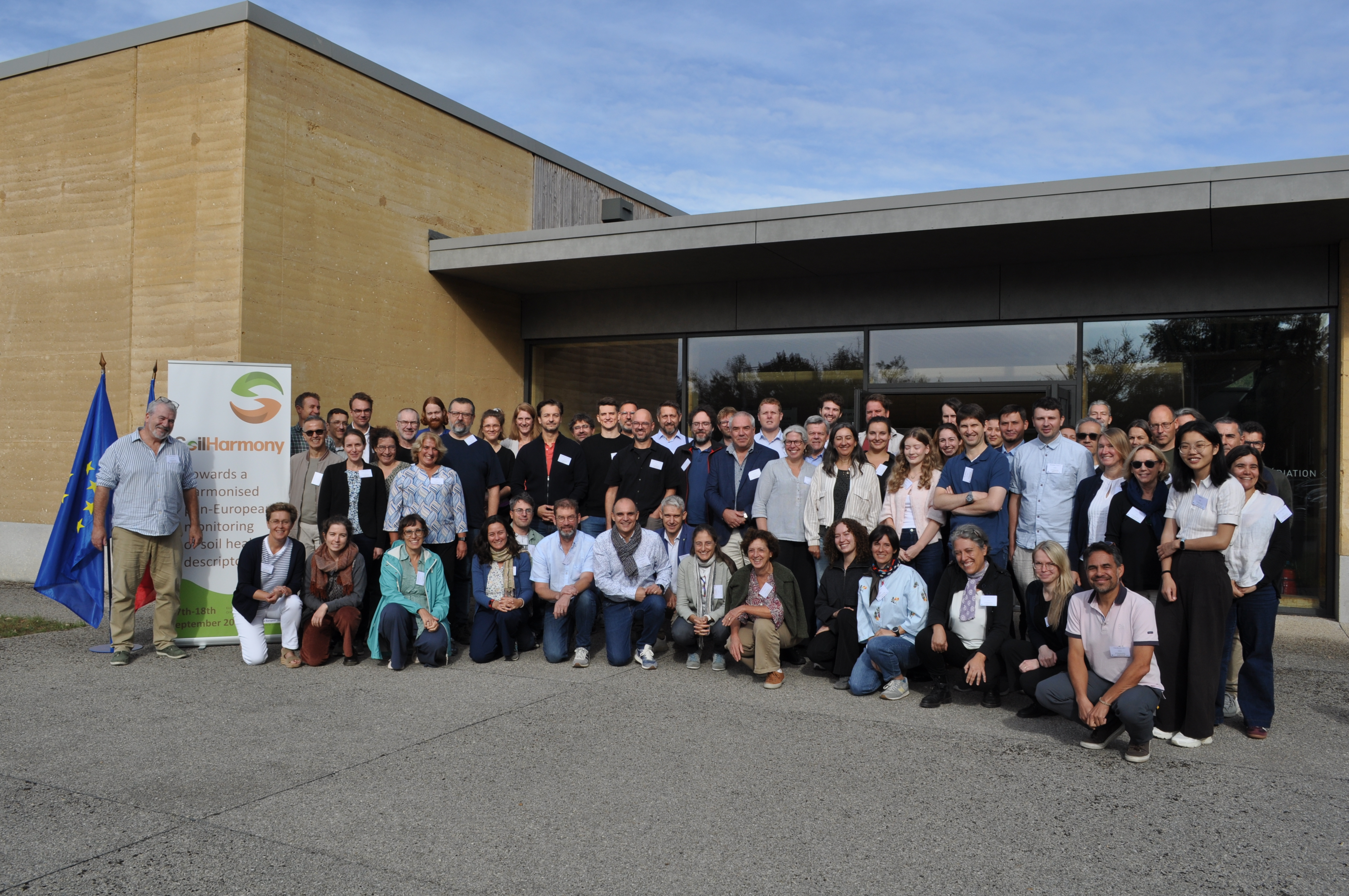
PRESS RELEASE - Around 60–70% of European soils are considered as degraded. Europe has adopted a new soil monitoring law in late 2025, and the SoilHarmony project has emerged to tackle the challenge of harmonising soil monitoring measurements and data at the EU scale. The 4-year project is coordinated by INRAE and has brought together 28 research partners in 21 countries. SoilHarmony aims to develop essential conversion tools that member states can use to preserve their current national monitoring systems while also supplying the standardised data required by the new law. The project was officially launched in Orléans, France, on September 17.
Published on 17 September 2026

Healthy soils are essential to agricultural production, biodiversity, water quality, and climate regulation. To better protect soil health, the EU issued a new directive in late 2025—the soil monitoring law (SML)—to ensure consistent and harmonised soil monitoring efforts by all member states. The SML established reference methodologies for numerous soil descriptors1 with a view to accomplishing two main objectives: to make it possible to compare soil health among EU countries and to generate reliable data for constructing policies related to climate, biodiversity, and agriculture.
However, on the ground, the reality is quite complex. Over decades, Member States have each established their own soil monitoring systems, which may rely on dramatically different sampling depths, field protocols, laboratory methodologies, and data models. As a result, pedological data in Europe are not comparable, interoperable, or in full compliance with FAIR principles. For example, the "quantity of organic carbon in the arable layer” may have different meanings depending on which country the sample came from.
Using conversion tools to facilitate a harmonised approach
SoilHarmony will develop and validate conversion tools, which will allow countries to retain their national soil monitoring systems (and all their historical data) while also supplying harmonised data to the EU.
One of the project's primary goals is to develop two conversion tools: transfer functions and pedotransfer functions. For a given soil descriptor, transfer functions can convert the results obtained with one method to the equivalent results from the reference method. Pedotransfer functions use combined data on easy-to-measure soil descriptors to estimate other soil descriptors that are difficult or expensive to measure directly. These two tools are crucial to the practical implementation of the SML.
SoilHarmony will make use of current national soil monitoring systems2 and LUCAS, the EU’s land use and land cover survey programme that serves as a common reference resource. Transfer functions already exist, but they are scattered throughout the scientific literature, rarely validated, and largely fail to address both the soil descriptors in the SML and Europe’s wide range of pedoclimatic zones. SoilHarmony will directly tackle this issue by validating these functions at broad scales. The project will collect and analyse at least 4,000 new soil samples from 21 member states and from areas representative of at least 80% of the EU’s land surface area.
Developing a statistics toolkit and user-friendly web application
SoilHarmony also aims to develop a statistics toolkit and user-friendly web application that will make the conversion tools available to any public authorities, advisors, or researchers who might need them. The project will generate a database that follows FAIR principles and an open-access metadata catalogue, which means the results will remain available after the project’s end. This work will be carried out in close collaboration with the EU Soil Observatory run by the European Union's Joint Research Centre (JRC).
Project in brief
SoilHarmony: September 2026–September 2030
Coordinated by INRAE—28 partners: INRAE (FR), CREA (IT), AU (DK), SLU (SE), EV INBO (BE), ISRIC (NL), CSIC (ES), NIBIO (NO), ISPRA (IT), CRA-W (BE), AGES (AT), ARPAV (IT), ASTA (LU), CZU (CZ), ELGO (EL), ERDYN (FR), IAPAS (PL), INIAV (PT), IUNG (PL), LAMMC (LT), LBTU (LV), LUKE (FI), METK (EE), TEAGASC (IE), TI (DE), VUMOP (CZ), WR (NL), ATK (HG)
Horizon Europe funding: €6M
Horizon Europe Project no. 101296615, funded via the call for proposals HORIZON-MISS-2025-05-SOIL-04 - Developing transfer functions for the Soil Monitoring Law DOI: 10.3030/101296615

1. e.g., soil organic carbon, pH, bulk density, extractable phosphorus, electrical conductivity, concentration of heavy metals (zinc, copper, cadmium…).
2 . France’s national soil monitoring system (Réseau national de mesures de la qualité des sols) has been gathering long-term soil data since 2000. The system is funded by the scientific interest group Sol (GIS Sol) and is coordinated by the Info&Sols research unit at the INRAE Centre of Val de Loire. It relies on observations collected at regular time intervals (every 10–12 years) at nearly 2,200 established monitoring sites. https://www.gissol.fr/le-gis.