

Biodiversity Reading time 3 min
A newly discovered role for tension wood: the “muscle” trees use to correct their posture
PRESS RELEASE - A research team from INRAE and the University Clermont Auvergne has shown that trees are capable of correcting a curvature they detect in their stems through a specific biological process. In the study, young trees with bent stems were placed in an experimental set-up that prevented them from sensing their orientation relative to light and gravity. The only sense remaining to the trees was the perception of their own curvature. Under these conditions, the scientists observed the formation of a particular type of wood, known as tension wood, which acts like a muscle to correct the curvature of the stem, allowing it to realign within a few weeks. Published in New Phytologist, the findings show how plants—under natural conditions—finely perceive their own shape and combine this information with signals relating to their orientation to adjust their posture. This ability plays an important role in their resilience when faced with extreme events such as storms or landslides.
Published on 02 September 2026

Proprioception is the sense through which living organisms perceive the position of their body parts, and it was long believed to be specific to animals. In 2012, a research team involving INRAE demonstrated that plants also possess this ability (Bastien R. et al., PNAS). This is what enables them to control their posture and remain as straight as possible (Moulia et al., Science). However, the biological mechanism governed by this proprioception remained unknown.
An experimental set-up to deprive plants of all senses except proprioception
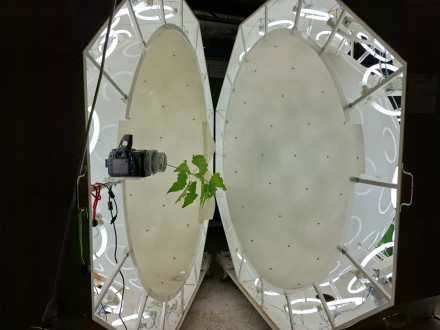
Plants orient their growth in response to factors they perceive, including gravity, the direction of incoming light, and their own shape, that is, proprioception. To investigate proprioception on its own, all other sensory inputs must be eliminated. To remove the sense of gravity and the influence of light direction in trees, the scientists placed the specimens under study in a specially designed experimental set-up: a horizontal platform rotating around its own axis inside a sphere flooded with light coming simultaneously from all directions.
Tension wood: a “muscle” that can both bend and straighten plants
The researchers first placed young poplar trees in a horizontal position. Over time, the trees curved upwards, bringing their tops back to a vertical orientation. This movement is driven by a particular type of wood: tension wood. It acts like a muscle that by contracting exerts a pulling force on the upper side of the stem, causing it to bend upwards. After around ten days, once the trees had reached a sufficient degree of curvature, they were transferred to the experimental device. Over the following weeks, the stems gradually straightened and returned to a rectilinear shape. The scientists examined the anatomy of the wood formed during this straightening movement. The formation of tension wood on the upper side, which had caused the stem to bend upwards, ceased when the device was activated, while a wood identical in every respect formed on the opposite side. The latter appears to function as an antagonistic muscle, generating a pulling force in the opposite direction and progressively restoring the stem to a straight form. Tension wood formation is a complex biological process that is regulated at the cellular level and unfolds through several successive stages. The process is also governed by the plant's proprioception.
Until now, tension wood was thought to form only on the upper side of a stem, causing it to bend upwards. It can be observed, for example, at the base of trees growing on mountain slopes. This study shows that tension wood can play antagonistic roles, much like the muscles in animals that maintain their posture and enable their movements. These results show that plants combine fine perceptions of their environment (such as light and gravity) with an awareness of their own shape. They integrate and process this information to activate tension wood in different directions, thereby achieving or maintaining the most appropriate posture. These key abilities contribute to the resilience of trees when faced with extreme events that can alter their position, such as storms or landslides, a trait of particular importance in the context of climate change. The findings also open up new avenues for the selection of cultivated plants based on their proprioception, by promoting plants that remain upright and, for example, helping to combat lodging1 in cereal crops.
“What we have uncovered is a genuine sensorimotor loop operating in the woody parts of trees! Poor coordination in the successive activation of tension wood results in excessive internal tension, which can affect wood quality. These findings therefore reshape more applied research aimed at improving wood quality... and at obtaining trees that are as straight and as relaxed as possible, whatever life throws at them!”
Bruno Moulia, INRAE research director
“Revealing the remarkable capabilities of trees requires a great deal of ingenuity. In this project, we achieved it by bringing together researchers from different disciplines, with complementary skills and perspectives. This requires time and perseverance, but these interdisciplinary discoveries show that the effort is worthwhile.”
Félix Hartman, INRAE research engineer
Reference
Caulus A. et al. (2026) Proprioception drives tension wood formation for autotropic straightening and postural control in trees. New Phytologist DOI: https://doi.org/10.1111/nph.71238
This work was supported by the CNES (French National Centre for Space Studies) and the IRC-SAE (International Research Centre on Sustainable Agroecosystems), part of the I-SITE CAP20-25 programme.