

Biodiversity Reading time 8 min
Adapting forests to change: the IN-SYLVA Europe project wins a place on the ESFRI 2026 Roadmap
Dedicated to the adaptation of forest ecosystems to global change and innovative forest management, the IN-SYLVA Europe Research Infrastructure, hosted and supported by France (through its Ministry of Higher Education, Research, and Space), has been selected for the 2026 European Strategy Forum on Research Infrastructures (ESFRI) roadmap, which sets the direction of European strategy for major research infrastructure. The project’s selection secures the coordination of a second international research infrastructure for INRAE, joining IBISBA, dedicated to industrial biotechnology, which was selected for inclusion in 2018.
Published on 22 July 2026

No forest adaptation without biodiversity, no biodiversity without forest adaptation.
The concept and design of IN-SYLVA Europe is based on an established French model, IN-SYLVA France, which was set up in 2017 and has featured on the French National Research Infrastructure Roadmap since 2018. The concept of forest management infrastructure put into practice by IN-SYLVA France will now be widely transferred to international scale through IN-SYLVA Europe. This is under the guidance of an international coordination team (currently comprising five organisations from three countries), coordinated by INRAE with the assistance of CIRAD (the French agricultural research centre for international development), the University of Rouen Normandy (France) and the University of Copenhagen (Denmark), and Natural Resources Institute Finland (LUKE). Its originality lies in its integrated vision of adaptive forest management, covering a broad range of forest environments, from the temperate stands of mainland France (17 million hectares, representing 31% of the country’s land area) to overseas tropical stands (including 8 million hectares of forest in French Guiana). Its aim is to support forest socio-ecosystem adaptation in order to safeguard the long-term future of a multiplicity of ecosystem services. These include the sustainable production of timber and biomass for various purposes, the storage of carbon (in both trees and soils), and the maintenance of biodiversity, a key driver of forest productivity.
Information spanning over three decades from 200 000 experimental sites in 32 countries
‘IN-SYLVA Europe will rely on a network of experimental sites and their associated resources that reaches across many countries, providing coverage of large-scale European ecological gradients, and ensuring interoperability’, explains Jean-François Trontin, the Development Manager of the infrastructure. ‘European forests face enormous challenges’. Indeed they must adapt to the impacts of climate change and the compound effects of the many resultant environmental hazards (such as droughts, wildfires, storms or pests and diseases), while continuing to store carbon, conserve biodiversity, and supply timber. A Mediterranean forest, a mountain forest, or a Nordic forest will each respond differently to these pressures, and the responses will vary according to local circumstances (biology, environment and management, organisation of local industry, and land governance). To understand the problems and find solutions, we must be able to experiment by actively intervening in ecosystems, rather than merely observing what happens; above all, these experiments must be conducted in contrasting contexts. This is one of the major advantages of IN-SYLVA Europe, which has the potential for 200,000 experimental sites to be monitored over the long term (>30 years) across 32 countries, 12 of which are non-European.
A service provided to all who work towards sustainability in forest management
The European infrastructure must make it possible to test the effects of different forest management strategies (diversification of species and varieties, silvicultural regimes, management of the forest–wildlife balance, soil management, and wildfire risk management). It will produce data using shared protocols (international standards) and make this available to a wide range of communities working in the forest and timber sector. IN-SYLVA Europe’s services have accordingly been devised for use by scientists, but also by forest managers, businesses, public authorities, groups and associations and, more widely, by all members of society (including individuals) interested in the sustainable management of forests.
The infrastructure also addresses a limitation that is particularly problematic for long-term ecosystems such as forests: ‘We are seeking to set up long-term experiments. A forest doesn’t spring up in a year, like a wheat crop’, Jean-François Trontin stresses. For species whose life cycles often last for 80 to 100 years, and far longer in the case of oaks, the need for continuity in monitoring is a defining factor. Yet research projects are not always designed to support this sort of long-term data collection. ‘Since the 2000s, we have identified more than a hundred collaborative European projects on forest adaptation to climate change and other global changes’, explains Jean-François Trontin. ‘With funding for three or four years, once they come to an end, their results are dispersed, for lack of a common space where they can be shared and re-used’. This lack of a permanent structure was the starting point for IN-SYLVA France, and now for IN-SYLVA Europe. ESFRI’s latest strategic report (2021) and landscape analysis (2024) highlighted this critical need for a forest research infrastructure.
The single portal provided by IN-SYLVA Europe will give users access to experimental sites, samples, data and digital tools for data collection, analysis, and modelling. By using environmental gradients at a European scale (rather than a collection of individual sites) from the outset to tackle their research questions, researchers will be able to compare the responses of different types of forest ecosystem, to identify generic features and to pinpoint elements that are specific to their own topic of investigation. This will enable them to fine-tune solutions tailored to local circumstances, exploring, for example, the evolution of particular management practices or the identification of species and varieties that are more resistant to disruption’, he continues.
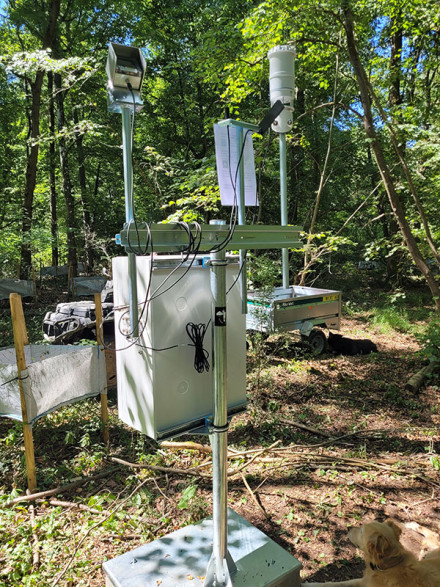
IN-SYLVA Europe: compiling diverse data
IN-SYLVA Europe's services provide data at various levels. Users can access raw data on the microclimates, tree growth, or timber quality, but they can also obtain mapped information (on soil properties, tree heights, biodiversity, etc.), or tools to help track forest dynamics (such as dendrometers, phenology cameras, etc.). More aggregated data allow for the assessment of new silvicultural methods or more adapted species and varieties. They can also provide input variables to test out scenarios co-produced by stakeholders using decision-support tools.
From the forest floor and the lab to modelling … and beyond, to training and knowledge transfer
The IN-SYLVA Europe infrastructure has been in preparation since 2023 and will become fully operational in 2034, but it can already offer access to over 200 services provided by some fifty organisations (including 45 research bodies) from 22 countries. The French ‘node’ (IN-SYLVA France) alone provides 52 of these services, which have already been used in numerous France 2030 programmes, in particular by the FairCarboN and ForesTT PEPRs (Priority Research Programme and Infrastructure). The services are based on three major interlinked areas of activity:
- field experimentation (in situ services),
- high-throughput laboratory analysis (in lab services),
- systems for data provision and analysis, including practical application through modelling and the development of simulation tools for decision-makers (in silico services).
These services produce a fourth pillar involving training and scientific knowledge transfer for those working in the forestry and timber sector, as well as wider society (in edu services).
The partnership, which already includes 21 European countries alongside New Zealand, is in a strong position at this stage of its development. It has obtained considerable political support (from the governments of thirteen countries) and funding commitments (from 27 institutions and the Ministers responsible for research infrastructures in France, New Zealand, and the Castile and León region of Spain). This has allowed it to meet the ESFRI’s threshold for project submission with ample room to spare. More than 90 European organisations have also already expressed their interest in this forest-focused initiative.
International reach
‘A further strength of IN-SYLVA Europe is that we managed to persuade the IUFRO (International Union of Forest Research Organizations) to join the consortium of 37 signatories to our Memorandum of Understanding (MoU)’, remarks Jean-François Trontin. ‘This means that we are going to be working together on issues with global reach’, since the IUFRO is the chief world organisation for international scientific cooperation on forests (with more than 630 member organisations in 115 countries). As an example, the partnership will allow various IUFRO ‘Task Forces’, set up to encourage interdisciplinary cooperation, to be mobilised – for instance the task force on the development of AI for Forest Science (TF54), to which members of IN-SYLVA Europe are already contributors.
‘We are very proud to be leading this vision for forest research at a European and international scale’, comments Sébastien Duplessis, head of INRAE’s EcoDIV Division. ‘We are truly convinced that IN-SYLVA Europe will provide the scientific community with the equipment, competences and skills it needs to produce new knowledge’.
Improved emergency response
The integration of the knowledge and skills available within the European infrastructure will enable researchers to respond better to emergency situations where their help is requested by public authorities or socio-economic actors. ‘Indeed, we regularly see requests to researchers that are frequently born out of crisis situations and require immediate responses. We are asked, “The forest is dying, what do you suggest?”’, reports Jean-François Trontin. ‘It is almost devastating to have to answer that, if we begin trials now, we will have an answer only in 5 10, 15 or 20 years’ time’. Researchers are aware of the urgency, and for this reason, they have long warned of the necessity of preserving and updating a scientific historical evidence base built by earlier generations. ‘Our predecessors have been planting different varieties using different silvicultural methods under different ecological circumstances for over a century now’, he reminds us. Those historical trials have fed into current research. By making such findings visible, accessible and useable, we are effectively creating the foundation for the work of future generations who will draw on the experiments that are being set up today. ‘A research infrastructure is also a collective memory bank’, he concludes.
IN-SYLVA France, the model adopted for Europe
‘IN-SYLVA France has, for nearly a decade (since 2017), been a key piece in the strategy developed by INRAE and EcoDIV to support researchers working on the functioning of managed forest socio-ecosystems’, stresses Sébastien Duplessis. Under the leadership of Laurent Saint-André (INRAE), who is also the coordinator of IN-SYLVA Europe, the French infrastructure brings together INRAE and six partners: the CIRAD (French Agricultural Research Centre for International Development), the CNPF (National Centre for Private Forest Ownership), the FCBA (Industrial Technical Centre of the Forest-Wood and Furniture sectors), the OFB (French Office for Biodiversity), the ONF (French National Forest Office), and the University of Rouen Normandy. Part of France’s National Infrastructure Roadmap since 2018, it leverages three areas of forest management – genetic resources, silvicultural regimes, and biogeochemical cycles, a service profile that IN-SYLVA Europe will now be able to support at European and international levels (South America, Asia and Africa).
A project whose stakes are central to national and European strategy
- In France: Stratégie nationale bas carbone (national low carbon strategy), Plan national d'adaptation au changement climatique (national climate-change adaptation plan), Stratégie nationale pour la biodiversité (national biodiversity strategy), Planification écologique (Taking Action, ecological planning), and the Programme National Forêt-Bois (national forest and timber programme) for 2027-2036, which is currently being produced.
- In Europe: The New EU Forest Strategy, EU Biodiversity Strategy and EU Soil Strategy, all for 2030, as well as the European FOREST Partnership, a ten-year partnership launched in June 2026.

IN-SYLVA Europe’s international coordination team
A 16-strong team from five research bodies across three countries has been tasked with coordinating the preparatory phase for the infrastructure which will now begin (2027 – 2030). Their expertise extends across many scientific areas of research, data and forest planning, as well as regulation, governance, law and finance issues.
Coordinator
Laurent Saint-André, INRAE (IN-SYLVA France Manager, Speaker at the ESFRI hearing)
Development Manager
Jean-François Trontin, INRAE (IN-SYLVA France Administrative and Technical Manager)
Coordination Team Members
INRAE: Céline Meredieu and Christian Pichot (IN-SYLVA France Deputy Manager and Information Systems & Data Manager, respectively), Luc Pâques, Hervé Jactel, Zhun Mao, and Cécile Robin
CIRAD: Loïc Brancheriau (IN-SYLVA France Deputy Manager)
University of Rouen Normandy: Lucie Vincenot
University of Copenhagen (Denmark): Annemarie Bastrup-Birk (Speaker at the ESFRI hearing), Thomas Nord-Larsen
LUKE (Finland): Mikko Kurttila (Speaker at the ESFRI hearing), Tuija Aronen, Virpi Alenius, Sanna Sorvari-Sundet